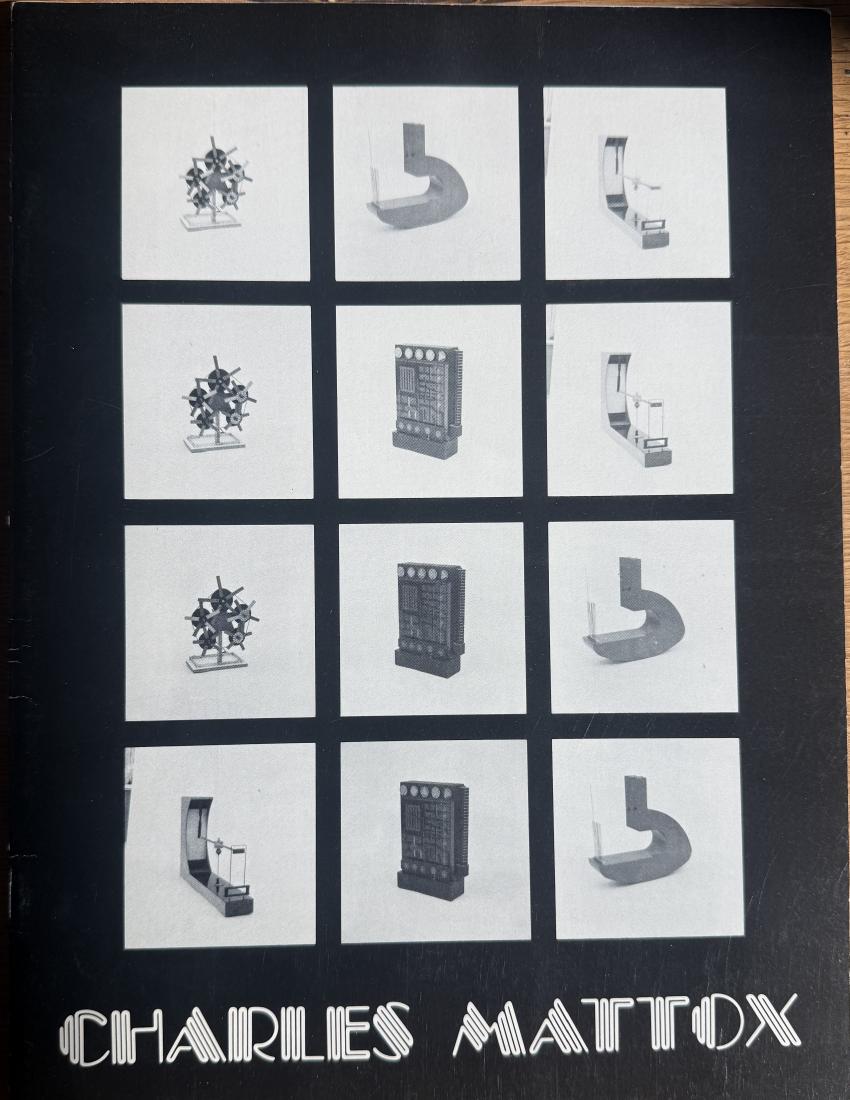
Charles Mattox
- Author
- Van Deren Coke
- Year
- 1978
- Publisher
- Art Museum, University of New Mexico
- Subject
- Charles Mattox
- Tags
- exhibition catalogue · kinetic sculpture · university of new mexico · interview · owner scan
Notes
Exhibition catalogue, Art Museum, College of Fine Arts, University of New Mexico, Albuquerque, 1978 (© Art Museum, 1978; printed by the University of New Mexico Printing Plant). Museum director Van Deren Coke wrote the introduction and conducted the interview that makes up most of the book. Staff credited: Donald McRae (acting dean), Van Deren Coke (director), Marian J. Hollinger Pope, Cleta H. Downey, William Masterson, Kay Wille, Sandra Edwards. Works were lent by the artist, Ed Janss, Dr. U. G. Hodgin, Jr. and Dr. Daniel Clifford. Mattox had retired from UNM in 1976; this is the museum's retrospective of his kinetic sculpture. Coke's introduction gives the most detailed account in print of Mattox's path to the machine. He was a builder of kites and wooden implements as a teenager in Kansas; his mother painted religious murals in Kansas churches and sent him on Saturdays to study with Birger Sandzén in Lindsborg. After the Kansas City Art Institute and private study with John Douglas Patrick, he hitch-hiked to Detroit to show his drawings to Diego Rivera, who told him to follow him to New York. He worked about nine months in Rivera's Fourteenth Street studio after the Radio City mural was stopped, grinding colour, preparing plaster and making cartoons. Through Lou Block he met Ben Shahn, then Arshile Gorky, Stuart Davis and Burgoyne Diller, whose hard-edge abstraction pulled him toward geometry. He spent four years on the WPA project, one as a painter and three as a technical director. Heading west in the mid-1930s, he taught at Commonwealth College, the labor school in Mena, Arkansas, and helped Will Schuster build Zozobra in Santa Fe. During the war he worked in California foundries and tool shops, designing aircraft-part moulds for Century Metal Craft and jigs and fixtures for Lockheed and Douglas contractors. From the end of the war until 1952 he made miniatures and special-effects devices in the Hollywood studios. The interview covers the rest: Los Angeles in the late 1940s, with no art scene and Lorser Feitelson's studio as the one meeting place. He began with wood and then metal, and his first moving works, shown with Felix Landau around 1948–49, ran on magnets, springs and timers rather than motors. Léger's theory of man and machine shaped his primary-colour palette. He sets himself apart from Calder and Rickey, whose work is moved by air, and feels closer to Tinguely, who worked with systems, though he rejects the Dadaist mockery of the machine. His reading on man and machine ran through Reuleaux (whose curves of constant width recur in his titles), Siegfried Giedion and Lewis Mumford. He wanted industrial colour with no brushwork, chosen by a numerical rule rather than by eye. He treats every motorised piece as expendable but tapes a circuit diagram and a motor list to its back so a conservator can repair it, and he names humour as essential. He recalls a show piece that sensed visitors, recorded what they said and played it back to them a few minutes later. His turn to sound came from afternoons with the composer Harry Partch (printed "Parch"), who suggested he amplify the whine of his motors and make it part of the work. He also describes a sound-making children's playground near Vancouver, colour-coded to a five-tone scale. On computers, he says Berkeley "wouldn't let me near a computer", while UNM's engineers and mathematicians gave him the feedback Berkeley had not. He calls the computer "the ultimate machine system" and predicts that graduate students' programs will soon let a computer design sculpture. That is the bridge to his ART1/DART1 plotter work at UNM, which the biography records as "numerous computer graphic shows" from 1969 onward. The back matter is a brief biography (born Bronson, Kansas, 1910), one-man and group exhibitions 1946–1976 (including Howard Wise Gallery 1966, Hayward Gallery "Kinetic Sculpture" 1970, Smithsonian travelling show 1970–72, Ronald Feldman video tapes 1976), public collections (LACMA, SFMOMA, Hirshhorn, Smithsonian, UNM and others), and reviews. Among the reviews are John Coplans in Artforum, Jules Langsner's "Mattox Machines" in Art News, and Mattox's own "The Evolution of My Audio-Kinetic Sculptures", Leonardo 2 (1969). The catalogue lists 35 three-dimensional works from Bird, 1940 ("first kinetic piece"), through Diode Flashing Piece, 1975 (circuit by Chilton Gregory) and Faster Egg, 1977, and 15 two-dimensional works from a 1930 Taos etching and a 1932 Pendulum Drawing to the Reuleaux and Three-D drawings of 1977. Full-page plates: Horizontal Pendulum (1963), 2 x 4 Ironer (1958), Small Drum Rocker (1965), Rotating Pentagon with Vibrating Rods (1964), Vibrating Rods (1965). The cover is a grid of twelve photographs of kinetic works. Pull quotes (Mattox, in conversation with Van Deren Coke): “I felt that technology—machines per se—were not a bad thing, but simply tools.” “If you have something that's moving and doesn't look mechanical people have a closer affinity to it. They are drawn into it, begin to study it, and they realize that they are seeing a system.” “Philosophically it was very important for me when I became involved with the computer because the computer is essentially the ultimate machine system.” “I am not making fun of machinery, but I am trying to make the piece have qualities which evoke a response.” “They should first enjoy the work, then maybe they should become involved with it and ask, ‘Why is it art?’” “I wanted no brushwork to show. I wanted the surfaces to be pure and clean.” “The University of California was, and still is, such a big institution they wouldn't let me near a computer.” “I think eventually it will be possible to use a computer to design sculpture.” Harry Partch to Mattox: “Why don't you amplify the sound and use the sound as part of the piece?” Noted: Coke dates Mattox's arrival in New York to 1931 "just at the time" the Radio City mural was stopped. The Rockefeller Center mural was halted in May 1933, so either the year or the sequence is off. The artist bio here follows the later account that he joined the team the day Rivera was dismissed. The catalogue spells Partch "Parch" and Lindsborg "Lindsberg" throughout. Provenance: the owner's own copy, photographed page by page on 23 October 2026 (17 pages including cover and imprint page). Each photo was cropped, perspective-corrected and evened for raking sunlight, then given an English OCR text layer. Fingertips holding the book open show in the lower margins of the last four pages; no text is covered. © Art Museum, University of New Mexico, 1978. File md5 7ac3ccdc60d0e44b3250c260e8e68219.