Writing the Hand into the Machine
Writing the Hand into the Machine
Vera Molnár’s Lettres de ma mère, 1981–1990
A study of memory, handwriting, algorithmic simulation, and the 1990 Vasarely Museum portfolio
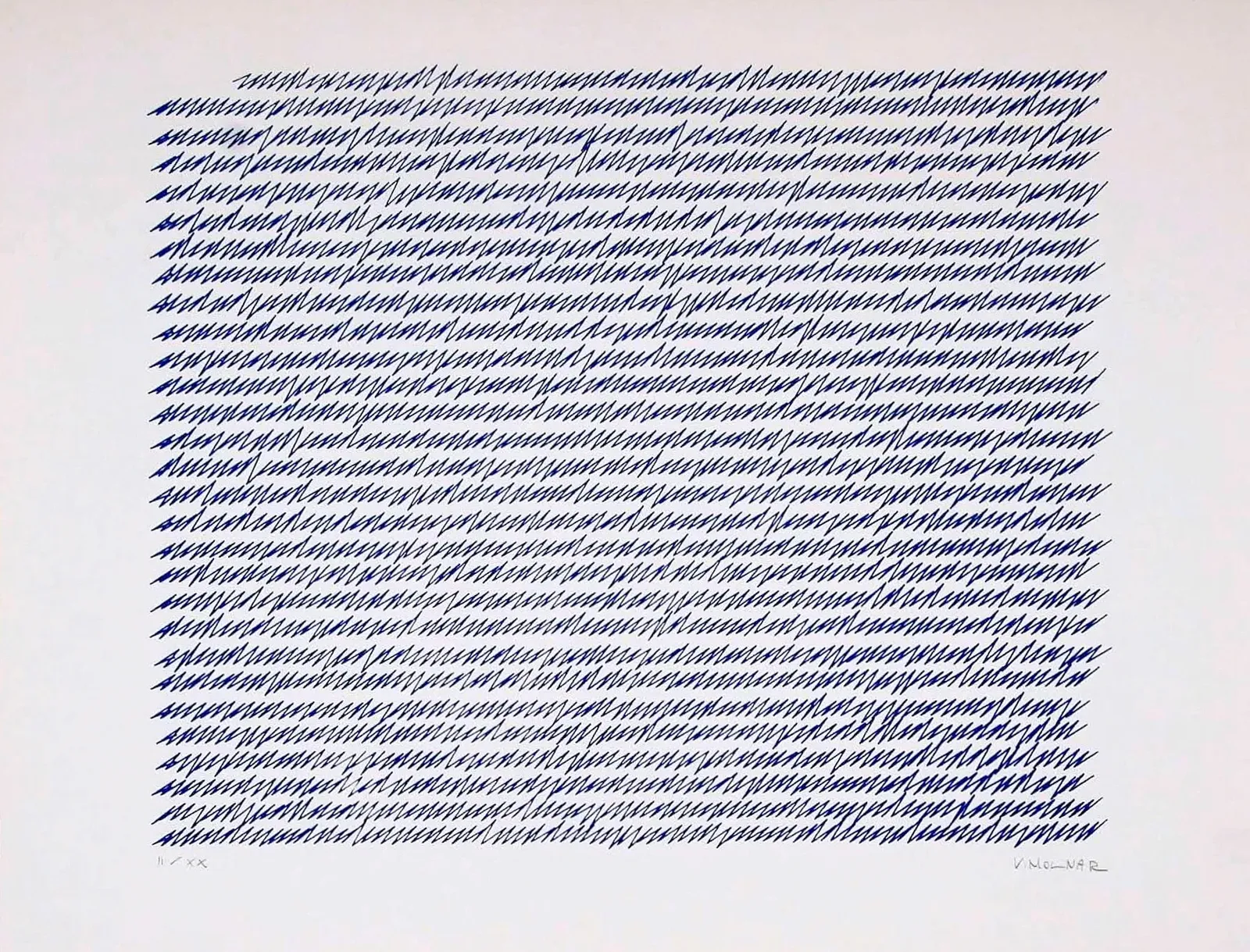
Collection case study: Vera Molnár, Lettres de ma mère I, 1990, silkscreen on paper, 32 × 42 cm, artist’s proof (EA), PION.2026.124.
Abstract
Vera Molnár’s Lettres de ma mère (My Mother’s Letters) is one of the most unusual bodies of work in the history of early computer art. Begun with hand-drawn sketches in 1981 and developed through computer programming, pen plotting, conventional printing, manual drawing, and eventually a six-print screenprint portfolio issued by the Vasarely Museum in Budapest in 1990, the series grew from Molnár’s memory of the weekly letters sent to her from Hungary by her mother, Erzsébet “Erzsi” Pollacsek. Rather than reproduce the semantic content of those letters, Molnár attempted to model the behavior of her mother’s handwriting: its progression from regularity toward agitation, its distinctive slant, and its increasing instability as her mother aged. The result is writing without language—marks that function simultaneously as simulated handwriting, abstract drawing, computational output, and memorial portrait.
This essay reconstructs the development of Lettres de ma mère from its surviving source letters and 1981 sketchbook studies through the computer program known as ANYAM, Molnár’s 1984 compositional experiments, the major plotted works of 1988, and the 1990 Vasarely Museum edition. It argues that the series complicates the traditional opposition between the expressive human hand and the supposedly impersonal computer. Molnár did not use computation to suppress gesture; she used it to analyze, reproduce, disturb, and ultimately reimagine gesture. In doing so, Lettres de ma mère became both an intimate work of remembrance and a sophisticated investigation of authorship, randomness, materiality, and the relationship between image and information.
Introduction: the personal work of a systematic artist
Vera Molnár occupies a foundational position in the history of computational and generative art. Born in Budapest in 1924 and trained as a painter, she moved to Paris in 1947 and began using electronic computers to generate visual work in 1968. Yet the importance of her practice lies less in simply being “early” than in the particular use she made of computation. Molnár approached the computer as an experimental instrument: a means of systematically varying images, introducing controlled randomness, challenging habitual aesthetic decisions, and testing the limits of her own visual judgment. Aline Guillermet has described this practice as a productive exchange between the apparently immaterial procedures of programming and the material history of drawing and painting.
Within that larger practice, Lettres de ma mère is exceptional because its starting point is explicitly biographical. Zsofia Valyi-Nagy, whose dissertation provides the most extensive archival study of the project, calls it Molnár’s most personal reference. Where other major series looked toward artists such as Dürer, Monet, Cézanne, Klee, Malevich, and Mondrian, here Molnár directed the same analytical attention toward the hand of someone who was not an artist at all: her mother. The series thereby brings domestic memory, migration, family correspondence, and bereavement directly into an artistic practice frequently described in terms of geometry, systems, mathematics, and abstraction.
The source: letters from Budapest
When Molnár left Hungary in 1947, her mother Erzsébet Pollacsek—known as Erzsi—remained in Budapest. Mother and daughter maintained a regular correspondence until Erzsi’s death in 1971. Molnár later recalled receiving a letter almost every week. A number of these letters survived in her archive, including examples from October 1969 that have been reproduced in Valyi-Nagy’s dissertation. The physical documents are significant because they establish that Molnár was responding not merely to an abstract memory of handwriting but to a body of actual correspondence she retained for decades.
Molnár remembered the handwriting less for what it communicated linguistically than for how it behaved visually. In her 1995 essay “My Mother’s Letters: Simulation by Computer,” she characterized it as simultaneously Gothic and “hysterical.” At the beginning of a line the script tended to be relatively regular and controlled; as it advanced toward the right-hand margin, it became increasingly restless and disordered. With age, Molnár recalled, the orderly aspect diminished while the agitation became more pronounced. The letters grew harder to decipher but remained, in her words, a significant experience for her “visual world.”
This description is fundamental to understanding the work. Molnár was not attempting handwriting recognition, transcription, or typographic imitation. The words of the original letters disappear almost entirely from the later artworks. What survives is a behavioral model: direction, rhythm, slant, repetition, instability, density, and change over time. The daughter transforms a linguistic message into a visual system.
There is also an extraordinary final episode in the history of the correspondence. Valyi-Nagy records Molnár’s recollection that after returning to Paris from her mother’s funeral in Budapest, she found another letter from Erzsi waiting in her mailbox. It had presumably been posted before her mother’s death. Molnár kept it with the others. The correspondence therefore ends with a temporal dislocation: the final material trace of her mother arrives after her mother is already gone.
January 1981: the first abstraction
The first known visual study for the project dates not from a computer session but from Molnár’s sketchbook. On January 5, 1981—her fifty-seventh birthday and exactly a decade after her mother’s death—Molnár drew two continuous zigzag lines in blue ballpoint pen and labeled the drawing Écriture de ma mère, “my mother’s handwriting.” On March 15 she returned to the idea, this time stacking five zigzagging horizontal bands so that the marks began to resemble the overall structure of a handwritten letter. Both sketches have survived and have been reproduced from Molnár’s journals.
These drawings reveal an important aspect of Lettres de ma mère: the computer did not invent the visual concept. Molnár first performed the abstraction herself. She observed handwriting, mentally decomposed it into a repertoire of movements, and reduced those movements to a system of angled strokes. Only afterward did programming become a means of exploring that system at a scale and degree of variability unavailable to unaided manual drawing.
This is characteristic of Molnár’s broader relationship to computers. Computation was rarely the origin of the artistic question. It was a device for extending a question already posed through drawing, perception, or an imagined algorithm. The machine allowed many closely related possibilities to be produced, inspected, accepted, rejected, or modified.
From handwriting to algorithm
By the middle of the 1980s, Molnár was explicitly using the computer to simulate her mother’s script. Her own technical description of the process is remarkably concise. The visual field consists of sequences of up-and-down strokes with an inclination of roughly 110 to 120 degrees. As each line moves from left to right, random variation is progressively increased. The system therefore begins with relative stability and ends with substantially greater disorder.
One can imagine the core procedure conceptually without reconstructing the original code. A nominally stable stroke has variables such as angle, height, horizontal spacing, and perhaps the location of its vertices. At the beginning of the line those variables operate within a narrow range. As horizontal position increases, the range from which values may vary becomes wider. The statistical possibility of deviation therefore increases as the plotted “writing” travels across the page.
The effect is surprisingly biological. Individual marks seem to hesitate, tremble, hurry, collapse, or collide with neighboring marks. But those expressive qualities do not originate in the immediate movements of a human hand. They emerge from parameters and random numbers executed by a machine.
This distinction is precisely what makes the series important. A viewer encounters what appears to be handwriting and intuitively reads character into it, yet there is no writer producing those particular marks. There are no words, no sentence structure, and no semantic message. Valyi-Nagy describes the resulting fields as asemic: they possess the appearance and conventions of writing while lacking conventional linguistic meaning.
ANYAM: the program behind the letters
Archival research adds an important technical detail that was absent from many earlier accounts of the series. According to Molnár’s notes and Valyi-Nagy’s interviews with the artist, the computer program associated with Lettres de ma mère was called ANYAM, Hungarian for “my mother.” It was developed for the Molnárs’ home computer, a BFM 186, described by Valyi-Nagy as a Franco-Japanese IBM-PC-compatible machine.
The authorship of ANYAM was collaborative. Molnár was involved in developing the program, but she did not write it entirely alone; her husband François Molnár and technically knowledgeable friends or assistants also participated. Valyi-Nagy identifies Lettres de ma mère as the latest major project in which Molnár herself remained substantially involved in writing the software. That history is useful because it resists the oversimplified image of the solitary artist-programmer. Early computational art frequently depended on networks of artists, programmers, research laboratories, engineers, machines, and institutional access.
The program name is particularly revealing. In the archive, what might otherwise appear as an abstract computational procedure is literally labeled “my mother.” The most intimate subject and the technical mechanism are given the same name.
1984: when simulation becomes composition
Molnár’s 1995 Leonardo article demonstrates that faithful simulation was only one part of her problem. The other was composition. Her mother’s handwriting created a field that was visually “wrong” according to many conventional compositional rules: stable on one side, increasingly chaotic on the other, without a symmetrical counterweight. Molnár described My Mother’s Letters as an opportunity to attempt to “compose badly”—to resist compositional habits so deeply learned that they had become almost automatic.
A group of experiments from 1984 shows her systematically testing that conflict. In one variation, rather than plotting every horizontal line separately and lifting the pen between them, Molnár instructed the plotter to draw the entire page as a single continuous line. On reaching the right edge, the pen traveled diagonally back toward the beginning of the next row. This created a powerful series of connecting diagonals and unified the sheet physically: what appeared to contain many lines was technically one uninterrupted stroke. Molnár concluded, however, that the resulting compositional unity reduced the convincing resemblance to handwriting.
Another experiment altered the direction of descender-like strokes comparable to those in letters such as f, g, j, p, q, and y, creating a counter-movement against the predominant forward lean. In another, Molnár relocated the zone of maximum disorder from the right side of each line into the center. The line would begin regularly, become chaotic midway across the page, then recover its regularity toward the right. The image became more conventionally symmetrical—but simultaneously less faithful to her memory of her mother’s handwriting.
This is the central experimental tension of the project. Improving the image according to inherited compositional rules could make the simulation worse. Improving the simulation could produce an image that violated the artist’s training. The work therefore becomes an experiment not merely in copying handwriting but in determining whether the visual logic of handwriting can itself constitute pictorial composition.
Randomness as simulated intuition
Molnár’s use of randomness has a longer history in her work. By the 1970s she was systematically introducing controlled deviations into geometrically ordered structures. The computer was valuable precisely because it could generate variations that she would not necessarily have chosen intuitively. Rather than surrender authorship to chance, she used chance to confront her own habits.
Guillermet connects Lettres de ma mère to Molnár’s contemporary interest in the possibility that random-number generation might simulate something resembling human intuition. Molnár’s diary entry of July 1, 1984 explicitly refers to using chance to simulate intuition, citing computer-art pioneer Frieder Nake. Within days, the journals move into handmade and computer-generated handwriting studies under the heading Lettres de ma mère. Guillermet appropriately stops short of claiming that Molnár explicitly equated the two projects, but the chronological proximity is striking.
In this context, randomness does something conceptually complicated. It makes machine-produced marks appear less mechanical. A perfectly repeated stroke immediately announces automation. A stroke subjected to carefully calibrated error can begin to suggest fatigue, temperament, hesitation, haste, nervousness, or physical limitation. Randomness becomes a tool for generating the appearance of subjectivity.
The 1988 works: expansion and intensification
By 1988, Lettres de ma mère had developed into an extensive group of plotted works. Molnár’s 1995 article reproduces six A3-size computer-and-plotter drawings from that year and explicitly describes them as simulations with increasing disorder. Read sequentially, they function almost like experimental states of a single visual proposition.
Other 1988 versions greatly expanded the physical dimensions of the work. The Musée de Grenoble preserves a computer-traced Lettres de ma mère in ink on paper measuring approximately 29.5 × 400 centimeters. Valyi-Nagy discusses related long-format works executed in India ink on Calcomp roll paper, emphasizing the significance of the continuous plotting surface.
At that scale, the metaphor of correspondence changes. The “letter” becomes a scroll, landscape, timeline, or continuous recording. The viewer can no longer apprehend the entire work as a conventional sheet of paper resembling correspondence. Instead, the repeated synthetic handwriting becomes duration: an extended passage from regularity through accumulation and disturbance.
Molnár also deliberately tested other output technologies. The Musée de Grenoble holds a 1988 Lettres de ma mère (sur imprimante) made using a printer rather than the pen plotter. The appearance is substantially different, reminding us that the algorithm alone is not the artwork. The output mechanism, ink behavior, paper, scale, and mechanical motion all participate in what the viewer perceives.
Hand and machine occupy the same sheet
The project ultimately became even more explicit about the difference between human and mechanical gesture. In later works Molnár superimposed actual hand-drawn marks over computer-generated traces. The Musée de Grenoble preserves a 1990 work cataloged as Lettres de ma mère (Étude main + machine), and other examples from approximately 1988–90 combine computer ink with manual intervention.
Molnár described these works as establishing a “dialogue between human and machine.” The phrase should be taken quite literally. The viewer can compare marks generated according to encoded procedures with marks generated by the immediate movement of Molnár’s body. What initially appears to be a confrontation between opposites becomes surprisingly ambiguous. The machine can produce hesitation; the hand can produce repetition. One may begin to question whether “human” and “mechanical” are stable visual categories at all.
Autography: whose hand are we seeing?
Aline Guillermet’s analysis of Lettres de ma mère centers on this problem of autography. Traditional theories of drawing and painting often invest the physical trace with a special connection to the person who made it. Brushstroke and handwriting can both function as evidence of presence: a mark is valued because this particular hand touched this particular surface.
Molnár disrupts that relationship. Her mother did not draw the marks in Lettres de ma mère. Vera Molnár did not physically draw most of them either. A computer calculated coordinates and a plotting mechanism moved a pen across paper. Nevertheless, viewers readily perceive the plotted marks as handwriting. Guillermet argues that Molnár’s manipulation of randomness produces effects such as trembling and hesitation that carry the perceptual associations of handmade marks.
There is a further paradox. The more effectively the simulation succeeds, the more strongly we may feel the absent hand of Molnár’s mother. Mechanical execution does not necessarily erase bodily presence. In this case, it can make absence palpable. A museum discussion of the series has similarly observed that the mother’s writing hand becomes present precisely through its physical absence from the computer-generated image.
The work therefore offers several possible authors simultaneously. Erzsi supplies the behavioral source. Vera identifies, abstracts, selects, and evaluates that source. Vera and her collaborators formulate computational procedures. The computer performs calculations. The plotter inscribes the surface. A printer or screenprinter may subsequently translate the plotted image into another material form. Authorship is distributed across a chain rather than located at a single point.
Image rather than language
Because the generated “letters” contain no readable message, Lettres de ma mère occupies an unstable territory between writing and drawing. Guillermet argues that the absence of syntax and semantics encourages viewers to experience the work pictorially rather than linguistically. We recognize “writing,” yet there is nothing to read.
This reversal is particularly poignant given the source material. A real letter normally derives its value from what it says. Molnár deliberately discards that level of information and retains something generally treated as incidental: the graphic characteristics of the writer’s hand. The content is lost while the carrier of personality becomes the subject.
The procedure resembles a form of compression. Thousands of words exchanged over decades are reduced to a comparatively small set of formal parameters. Yet the resulting reduction does not necessarily feel less personal. The tilt of a line, the instability of a rhythm, and the progression from order toward disorder can become carriers of identity even after lexical meaning has disappeared.
The 1990 Vasarely Museum portfolio
The project reached a particularly clear published form in 1990, when the Vasarely Museum in Budapest issued Lettres de ma mère as a portfolio of six blue screenprints. The Bibliothèque nationale de France records the portfolio as six serigraphs and gives the edition as 40 copies plus XX, indicating forty numbered impressions and a further Roman-numeral tranche. Molnár’s own published CV likewise lists Lettres de ma mère, 32 × 42 cm, issued by the Musée Vasarely, Budapest, in 1990.
The portfolio coincided with a significant Budapest presentation of Molnár’s work. The Museum of Fine Arts’ bibliography for the Vasarely Museum records the exhibition Vera Molnar: Lignes, formes, couleurs / Vonal, forma, szín, held from August 21 through October 14, 1990, accompanied by a twenty-four-page illustrated catalogue. Molnár’s text “Inconceivable Images,” an important statement of her serial and experimental method, was first published in that catalogue.
The relationship is especially fitting because Molnár describes the creation of a series as a process of comparison. Rather than producing large numbers of images for their own sake, she generated closely related states so that small differences could be inspected. Her concern was determining when a modification might produce the elusive visual event she considered art.
The six-print Lettres de ma mère portfolio embodies this method with unusual clarity. Instead of presenting one definitive image, it presents multiple states of a system.
The six prints: from measure to turbulence
The complete sequence survives in the Museum of Fine Arts, Budapest, and was reproduced in 2026 by The Yale Review as Lettres de ma mère I through VI. Yale characterizes the progression succinctly as moving from “measured to wild.”
Throughout the portfolio, the rectangular field retains the general proportions and density of written correspondence. Parallel bands traverse the page, constructed from repeated diagonal strokes. What changes is the degree to which order is disrupted. The relatively controlled early state gradually gives way to increasingly unstable lines and more conspicuous deviations from the underlying rhythm.
The sequence does not need to be understood as a literal representation of six particular letters. It is better seen as a set of states within Molnár’s simulated-writing system. The viewer effectively observes a parameter being pushed through different values. This is one of the fundamental visual structures of generative art: not simply an image, but a field of possible images defined by rules.
Yet biography changes the meaning of this otherwise formal procedure. “Increasing disorder” is not an arbitrary aesthetic slider. It derives from Molnár’s remembered observation of her mother’s changing handwriting. The system therefore occupies two domains simultaneously: an abstract experiment in controlled randomness and an encoded recollection of an individual body moving through time.
Memory as procedure
It would be tempting to describe Lettres de ma mère straightforwardly as a portrait of Molnár’s mother, and in a broad sense it is. But it is a portrait unlike almost any conventional portrait because it contains no face, body, name, voice, or readable quotation from its subject.
Instead, Molnár preserves a procedure.
She remembers how the handwriting begins. She remembers how it deteriorates across the line. She remembers its slant, nervousness, density, and rhythm. Memory therefore appears not as a static image stored intact in the mind but as a rule that can be repeated: this is how my mother’s hand behaved.
The computer is particularly appropriate to such a memory because programs also describe behavior rather than singular objects. A program specifies what should happen under particular conditions. In Lettres de ma mère, this procedural nature of computing intersects with the procedural nature of embodied habit. Handwriting itself is an algorithm of sorts: a learned sequence of movements repeated with continual variation.
Molnár reverses that analogy. Rather than claiming that the human hand is mechanical, she asks whether a machine can be made to reproduce the particular irregularities by which one hand becomes recognizable as belonging to one person.
Biography enters Concrete art
Valyi-Nagy’s scholarship is particularly useful in challenging the idea that Molnár’s systematic abstraction was emotionally or biographically neutral. Lettres de ma mère demonstrates how deeply a private history can inhabit apparently impersonal geometry. The source of the zigzags is separation between Budapest and Paris; the reason the letters exist is migration; the reason they end is death.
Yet Molnár never converts these facts into illustrative narrative. She continues to operate through repetition, parameters, chance, and serial comparison. Personal experience enters the system without turning the work into conventional expressionism.
That distinction is critical. The emotional power of Lettres de ma mère does not require Molnár to abandon abstraction. Instead, she demonstrates that abstraction itself can preserve biography. A tiny change in angular variation can be as biographically charged as an image of a face if the rule governing that variation comes from careful observation of a loved person.
Lettres de ma mère versus Lettres à ma mère
The series appears under two closely related French titles in the literature, and the distinction is worth preserving. The 1990 Vasarely Museum portfolio is definitively cataloged by the Bibliothèque nationale de France as Lettres de ma mère, literally “letters from/of my mother.”
Molnár also used Lettres à ma mère, “letters to my mother,” including for a text published in 1991 and for retrospective descriptions of the larger 1981–90 project. The Digital Art Museum accordingly catalogs the broader series as Lettres à ma mère (1981–1990) while separately documenting individual works titled Lettres de ma mère.
Rather than regularizing every title into one form, it is preferable to respect their documented contexts. Lettres de ma mère should be used for the 1990 portfolio and works bearing that title. Lettres à ma mère can appropriately refer to Molnár’s own retrospective writing about the larger project.
Conceptually, the shift is evocative. The original correspondence traveled from the mother to the daughter. Molnár’s later simulations can be understood as letters traveling in the opposite direction: constructions made by the daughter after the mother is gone.
PION.2026.124: identifying the collection impression
The impression in the Pettis Collection is presently cataloged as Vera Molnár, Lettre de ma mère, 1990, silkscreen on paper, 32 × 42 cm, an Exemplaire d’Artiste or artist’s proof, signed and dated in pencil. These physical details correspond closely with the documented dimensions and medium of the 1990 Vasarely Museum portfolio.
More specifically, a visual comparison between the collection image and the complete Budapest sequence reproduced by The Yale Review indicates that PION.2026.124 corresponds to Lettres de ma mère I, the first of the six portfolio images. The arrangement of the field and its relatively low level of disruption closely match the museum example identified as plate I.
This identification is strong enough to be useful catalogically, but one distinction should remain explicit in the collection research record: the plate number is presently established through visual comparison rather than through a visible printed “I” on the work itself or documentation accompanying the individual sheet. Accordingly, the most conservative catalog wording would be “Lettres de ma mère I, from the portfolio Lettres de ma mère, 1990; identification based on comparison with the Museum of Fine Arts, Budapest set.”
The edition notation also deserves care. The BnF records forty examples plus XX. The Pettis impression is marked EA. Those facts are not necessarily contradictory—artist’s proofs may exist outside or alongside formal numbered tranches—but an EA impression should not automatically be equated with one of the XX Roman-numeral copies without evidence from the original portfolio colophon or provenance documentation.
The recommended catalog title is therefore Vera Molnár, Lettres de ma mère I, 1990, with “from the portfolio Lettres de ma mère, published by Vasarely Museum, Budapest” added to the extended object information.
Why plate I matters
Seen alone, Lettres de ma mère I can initially appear almost typographic. Its repeated strokes are orderly enough to resemble a dense paragraph written in an unfamiliar script. Small disturbances interrupt that order without overwhelming it.
Within the complete set, however, the first plate assumes a different function. It establishes the baseline from which subsequent images can diverge. Its restraint makes later turbulence legible.
One might describe it, cautiously, as the nearest thing the portfolio has to a control state. This is an interpretive rather than archival designation, but it is consistent with Molnár’s experimental practice: establish a structure, vary one or more parameters, then compare the resulting states.
For a collection concerned with computer and machine art, plate I is therefore especially revealing. The image does not advertise technological spectacle. There is no pixel grid, cathode-ray glow, computer terminal, or visual cliché of digital technology. Instead, the technological question is embedded inside something extremely old and human: the appearance of a handwritten letter.
From code to plotter to screenprint
The 1990 portfolio also complicates the medium of the work. The imagery originates in an algorithmic and plotter-based process, but the collected object is a screenprint after a plotter drawing. Contemporary catalog descriptions of the portfolio make that relationship explicit.
This creates a chain of translations:
The mother’s physical handwriting becomes Molnár’s memory of handwriting. That memory becomes a simplified hand-drawn schema. The schema becomes a computer program. The program becomes coordinates. Coordinates become the movement of a plotter. A plotted drawing becomes the source for a screenprinting process. The screenprint becomes a reproducible editioned object.
At each stage, information is transferred from one medium to another. Something is preserved, something is lost, and something new appears.
Guillermet’s broader argument about Molnár is particularly useful here: digital information is never experienced in isolation from material embodiment. In Lettres de ma mère, the qualities we identify as “handwriting” depend not only upon code but upon visible lines physically instantiated on paper. Ink and paper allow computer-generated information to enter the visual history of drawing.
The 1990 screenprint extends that material history one stage further. The algorithm has become a multiple.
Against the idea of the impersonal computer
One persistent criticism of early computer art was that machine-generated work necessarily lacked individuality. A machine could repeat, calculate, and execute, critics argued, but it could not contain the “hand” of the artist.
Lettres de ma mère turns that criticism inside out.
The entire work is about a hand.
More precisely, it is about how little information may be necessary for us to experience the presence of a hand. The computer does not need to reproduce every original letter. It does not even need to reproduce recognizable alphabetic characters. A set of tendencies—angle, rhythm, directional bias, instability—can be sufficient to evoke individuality.
Guillermet cites computer-art historian Erwin Steller, who regarded My Mother’s Letters as an answer to accusations that computer drawings were impersonal and could not preserve the artist’s Handschrift. The German term is especially productive because it can mean handwriting literally while also suggesting an artist’s signature style or personal trace.
But Molnár complicates even Steller’s formulation. The Handschrift being simulated is not exactly the artist’s. It belongs to the artist’s mother. The work therefore asks whether individuality can be transmitted through another person, through abstraction, through software, through a drawing machine, and finally through editioned printmaking.
The answer produced by the work appears to be yes—but never perfectly. The imperfections are precisely what make the transmission persuasive.
Relevance to contemporary generative art
Seen from the perspective of contemporary generative systems, Lettres de ma mère can appear remarkably current. There is an input model, a set of parameters, stochastic variation, multiple outputs, selection by the artist, and translation between digital instructions and physical artifacts.
Yet it is important not to collapse Molnár’s practice into present-day generative AI. ANYAM was not a statistical model trained on a massive dataset, and it did not independently infer the characteristics of Erzsi’s handwriting. The abstraction was Molnár’s. She decided what qualities mattered and designed a rule-based system capable of producing variations upon them.
The intelligence of the project therefore lies not in automatic recognition but in formal reduction. Molnár asks the artist’s question: What is the minimum system required for this mark to still feel like this particular handwriting?
This problem remains relevant to contemporary computational creativity. What makes a generated output feel authored? Where is intention located when a rule produces many possible results? How much deviation can a system tolerate while retaining identity? When does randomness look expressive rather than arbitrary? And what happens to authorship when a human creates rules that another mechanism executes?
Molnár was investigating these problems decades before the current vocabulary of prompts, models, and generative AI made them commonplace.
Conclusion
Lettres de ma mère begins with an absence. A weekly correspondence that had lasted for more than two decades stops. Ten years later, Molnár draws two zigzag lines.
From those lines develops an extraordinary chain of experimentation: sketchbook studies, formal analysis, algorithms, random-number generators, a collaboratively programmed system named ANYAM, plotter drawings, continuous paper rolls, printer experiments, hand-and-machine hybrids, and finally a six-part screenprint portfolio published in Budapest.
The series is therefore simultaneously memorial and technical, private and systematic. It refuses the conventional distinction in which the human hand represents emotion while the computer represents rationality. Molnár uses rational procedures to approach an emotional memory and uses a machine to reconstruct the irregularity of a body.
What survives of her mother is not a readable message. It is movement.
The individual words disappear; the rhythm remains. The daughter converts that rhythm into rules, then allows those rules to generate new marks that her mother never made. This is not reproduction in the ordinary sense. It is an act of reconstruction through abstraction.
In Lettres de ma mère, the computer becomes a machine for remembering.
Selected bibliography and research sources
Molnár, Vera. “My Mother’s Letters: Simulation by Computer.” Leonardo 28, no. 3 (1995): 167–170. Molnár’s primary account of the simulation, compositional experiments, increasing-randomness system, plotter and printer works, and hand/machine combinations. Read the article
Valyi-Nagy, Zsofia. Vera Molnar’s Programmed Abstraction: Computer Graphics and Geometric Abstract Art in Postwar Europe. Ph.D. dissertation, University of Chicago, 2023. The most important archival study of Lettres de ma mère, including the 1981 sketchbook pages, reproductions of Erzsi Pollacsek’s 1969 letters, research into ANYAM and the BFM 186, and extensive oral-history work with Molnár. University of Chicago record
Valyi-Nagy, Zsofia. Essay on Molnár and the reenactment of Lettres de ma mère, discussing the January 5, 1981 sketch, the surviving correspondence, asemic writing, and the reconstruction of Molnár’s computational method. Read the Artforum essay PDF
Guillermet, Aline. “Vera Molnar’s Computer Paintings.” Representations 149, no. 1 (Winter 2020): 1–30. DOI 10.1525/rep.2020.149.1.1. A major analysis of materiality, randomness, autography, painting, and Lettres de ma mère. Read the author manuscript
Bibliothèque nationale de France. Catalogue record for Vera Molnár, Lettres de ma mère, Vasarely Museum, 1990. Records six blue screenprints and the edition as forty examples plus XX. BnF catalogue record
Musée de Grenoble. Collection records for Lettres de ma mère, 1988, computer-traced ink on paper, approximately 29.5 × 400 cm; Lettres de ma mère (sur imprimante), 1988; and Lettres de ma mère (Étude main + machine), 1990. These objects document the range of output techniques explored within the project. Long 1988 plotter work 1988 printer work 1990 hand + machine study
The Yale Review. “Vera Molnar’s Computer Drawings of Her Mother’s Handwriting,” 2026. Reproduces the Museum of Fine Arts, Budapest set of the six 1990 screenprints individually identified as Lettres de ma mère I–VI. View the complete six-print sequence
Vasarely Museum / Museum of Fine Arts Budapest bibliography. Records Vera Molnar: Lignes, formes, couleurs / Vonal, forma, szín, Vasarely Museum, Budapest, August 21–October 14, 1990, and its twenty-four-page exhibition catalogue. Vasarely Museum bibliography PDF
Digital Art Museum. Archival documentation of Lettres à ma mère (1981–1990) and individual Lettres de ma mère works from 1987 and 1990. Useful for distinguishing the broader series title from titles of individual works. Series record
The Bre Pettis Collection of Computer Art. PION.2026.124, Vera Molnár, Lettre de ma mère, 1990, 32 × 42 cm, artist’s proof. Primary object record for the impression discussed in this study. Collection record