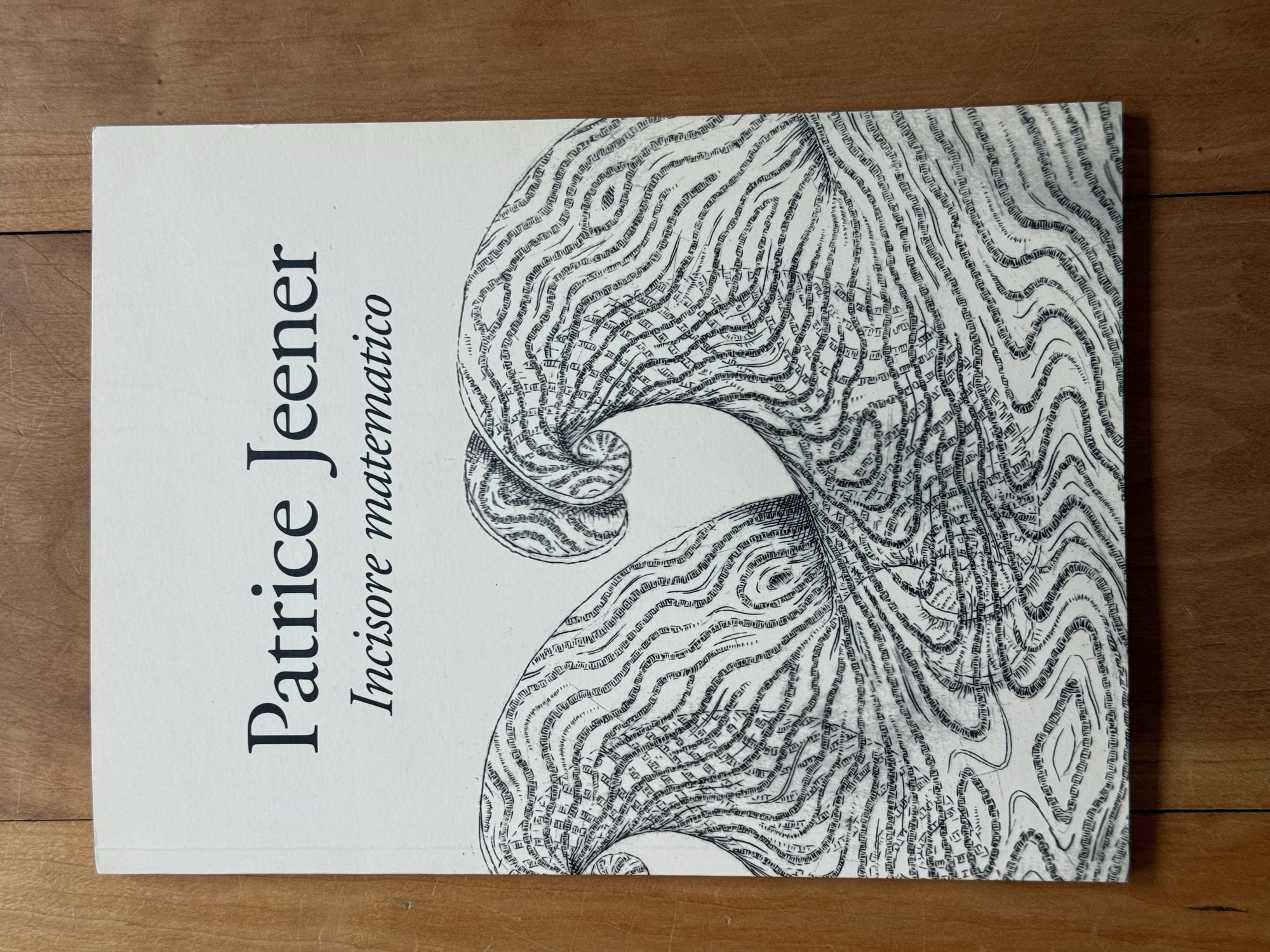
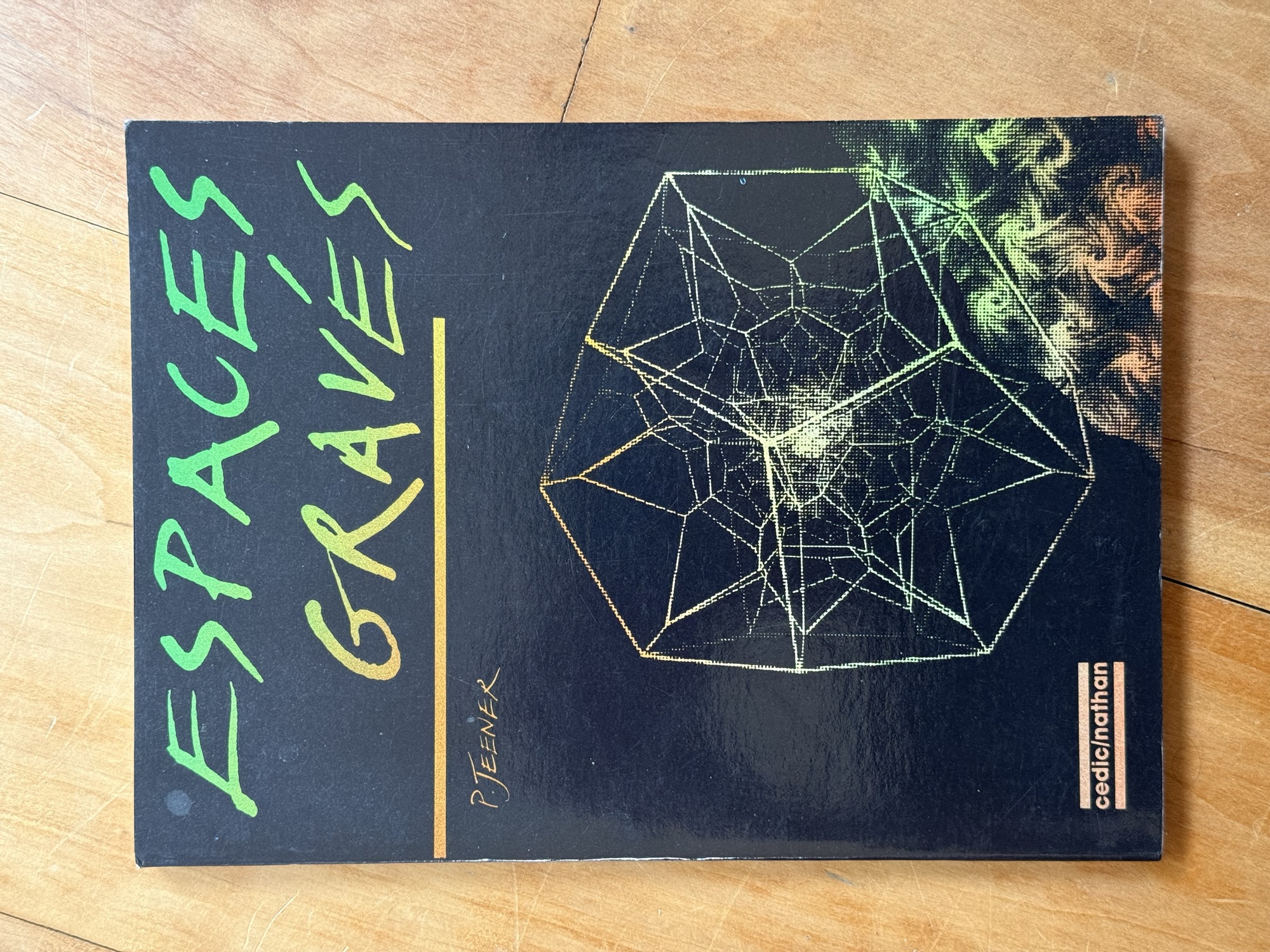
Self-portrait engraving, from Patrice Jeener: Incisore matematico (Edizioni Kangourou Italia, 2019)
Patrice Jeener
Patrice Jeener (1944–2026), le graveur de mathématiques, spent sixty years engraving the shapes of mathematics into copper. Paris-born and Beaux-Arts trained in the engraving atelier (1963), influenced by Escher and by treatises on curvilinear perspective, he worked from formulas and from the plaster mathematical models of the Institut Henri Poincaré — minimal surfaces, Klein bottles, four-dimensional polytopes — exhibiting at the Palais de la Découverte for nearly three decades and at the IHP, which produced the 2016 documentary that fixed his epithet. From 1996 he worked in the village of La Motte-Chalancon in the Drôme, engraving mathematics and painting the landscape around him, until his death in March 2026 — at work, the notices say, on one of his marvelous mathematical engravings. I bought the books about Jeener long before I ever discovered any of his work for sale. His prints aren't made with a plotter — but they're "plotted" all the same, the way a graphing calculator plots: equations traced point by point into visible form, just with a burin in a human hand instead of a pen in a machine's.
4 physical works