Keijiro Satoh
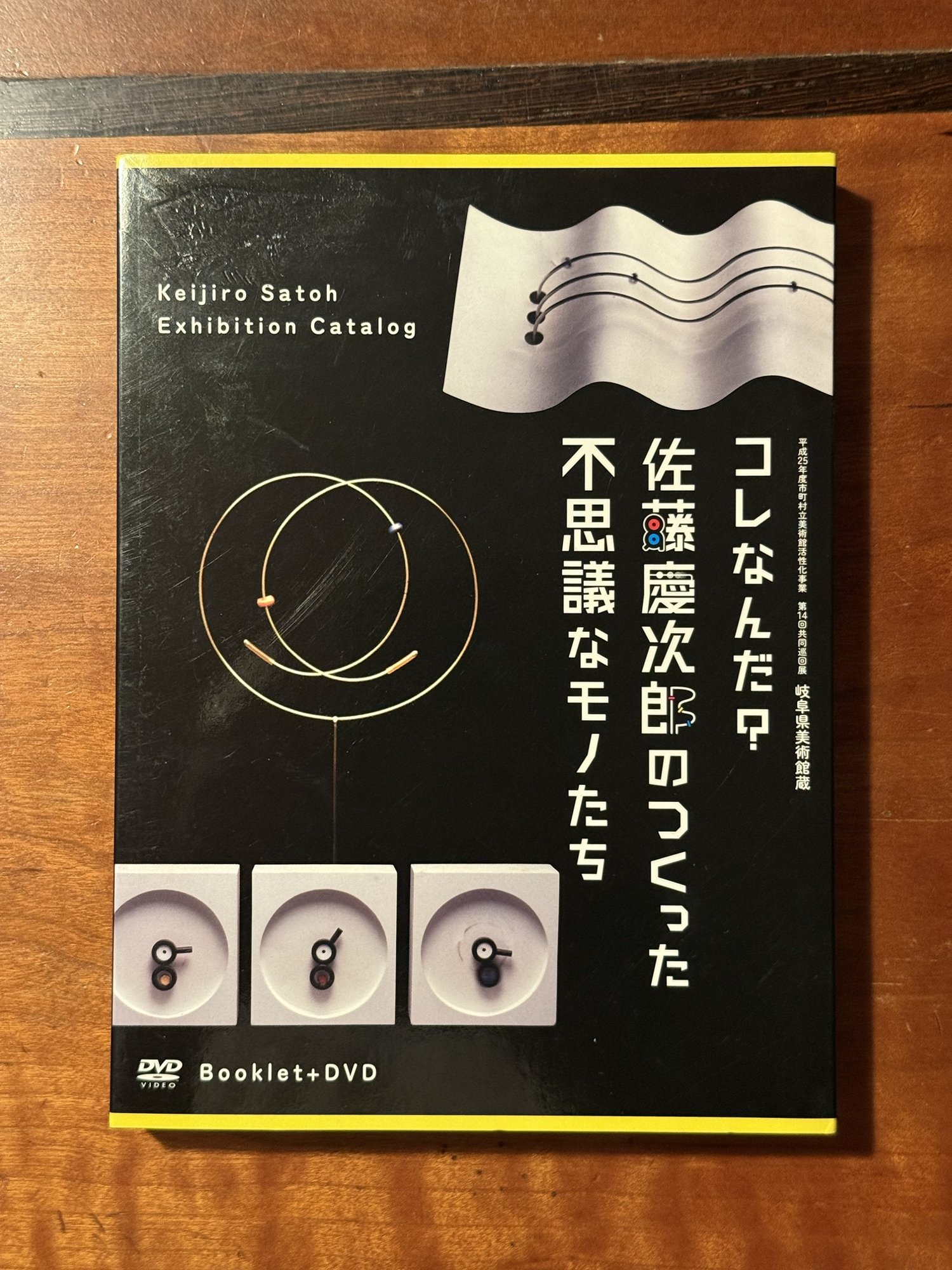
Keijiro Satoh (佐藤慶次郎, 1927–2009) was a Japanese composer who became a maker of small vibrating objects. Born in Tokyo, he studied composition with Fumio Hayasaka from 1949 while qualifying as a doctor at Keio University School of Medicine (1952). In 1953 he joined Jikken Kōbō, the Experimental Workshop gathered around Shūzō Takiguchi, alongside Tōru Takemitsu, Jōji Yuasa, Katsuhiro Yamaguchi and the printmaker Tetsurō Komai, and his music was played in its concerts: Lento and Allegro for piano and orchestra took second place in the Mainichi/NHK competition in 1954, and Calligraphy for Piano (1960) was chosen for the ISCM World Music Days in 1961. He described a John Cage concert in Tokyo in 1962 as a moment of kenshō (見性), the Zen awakening to one's true nature. With Toshi Ichiyanagi he designed the sound for the Mitsui pavilion at Expo '70 in Osaka. From the early 1970s he turned from the concert hall to objects: thin wires, rings and beads, small dishes and sheets, built with a physician's knowledge and parts from medical and audio equipment, that hum, sway and tremble when set in motion electrically. He showed them as "The Joy of Vibration" at Minami Gallery, Tokyo, in 1974, in "The Strange World of Vibration" with Wen-Ying Tsai at the Isetan Museum of Art in 1980, and in "Electra" at the Musée d'Art Moderne de la Ville de Paris in 1983, and went on exhibiting them at Expo Seville (1992) and Images du Futur in Montreal (1994). He kept composing too, with computer pieces such as Inverse No. 4 (1992) and Ikanaze No. 9 (2003). The Gifu Prefectural Museum of Art, which showed him in 1983 and, with the poet Michio Mado, in 1999, holds the main collection of his objects; Tama Art University Museum surveyed them as "Monominahikaru" in 2012, and about thirty toured Sasebo, Anjō and Koganei in 2013 as "What Is This? The Strange Things Keijiro Satoh Made".
Works in the collection
No published works yet.